The "Input" Secret: How to Learn 1,000 Chinese Words Without Opening a Textbook

Let’s be honest: traditional Chinese textbooks can be incredibly demotivating. You spend weeks memorizing lists of isolated characters, practicing grammar patterns you’ll probably never use in real life, and rewriting Hanzi until your hand cramps.
Then, you try to watch a Chinese show or chat with a native speaker, and you realize you don't understand a single thing.
If this sounds familiar, you aren’t bad at languages. You’re just using an outdated method. Polyglots and language experts have a secret weapon that skips the textbook grind entirely. It’s called Comprehensible Input, and it’s the fastest way to absorb 1,000+ Chinese words naturally.
What is the "Input" Secret?
Coined by linguist Stephen Krashen, the theory of Comprehensible Input states that we acquire language when we understand messages—when we comprehend what we hear or read.
Think about how you learned your first language. You didn’t study grammar rules as a toddler; you listened to sentences in contexts that made sense to you.
When you read or listen to Chinese that is just one small step above your current level, your brain automatically does the heavy lifting. It uses the context clues to figure out new words, locking them into your long-term memory without forced flashcard drills.
How to Build Your "Input" Routine
To learn 1,000 words without a textbook, you need to ditch the random memorization and follow a simple, input-driven strategy:
Find Your Sweet Spot: Choose content where you already understand about 70–80% of the words. If a text is too hard, it becomes stressful gibberish. If it's too easy, you won't grow.
Prioritize Real Stories Over Word Lists: Human brains are wired to remember stories, not isolated data points. Learning the word 苹果 (apple) in a funny story about a bad date is infinitely stickier than seeing it on an index card.
Focus on High-Frequency, Modern Culture: Don't waste time on ancient prose if your goal is conversational fluency. Focus on reading about modern lifestyle trends, internet jokes, or daily scenarios.
The Problem with Native Content (And the Solution)
The biggest challenge with the Input Method is finding the right material. Jumping from a beginner textbook straight into native Chinese news apps or novels is like hitting a brick wall—the vocabulary gap is just too massive.
That is exactly why Read Bean was created.
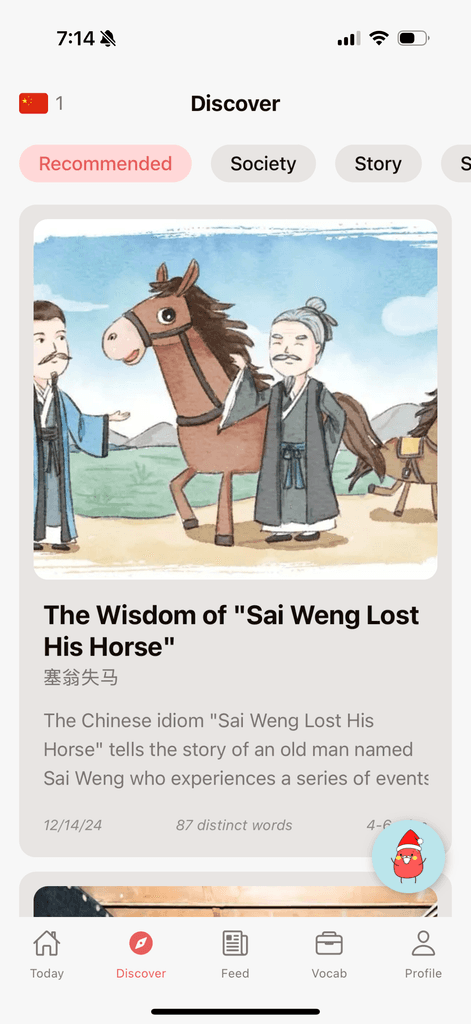
Read Bean acts as the perfect bridge, turning real-world Chinese culture, viral internet trends, and engaging stories into bite-sized reading material scaled exactly to your level.
Instead of dealing with overwhelming walls of text, Read Bean gives you:
Context-Rich Lessons: Tap any word you don't know for instant definitions and pinyin, keeping your reading flow completely uninterrupted.
Bite-Sized Stories: Read articles tailored to your actual vocabulary capacity, featuring fascinating topics like Chinese youth culture, viral slang, and historical deep-dives.
Bridges to Speaking: Once you absorb the vocabulary through reading, Read Bean's interactive AI Roleplay feature lets you actively use those exact words in simulated real-life conversations—giving you instant feedback on your pronunciation.
Start Acquiring Chinese
You don't need to lock yourself in a room with a grammar guide to build a massive vocabulary. By feeding your brain steady, engaging, and understandable Chinese content, reaching your first 1,000 words happens naturally.
Ready to trade the textbook grind for real-world stories?
Download Read Bean for free today and start acquiring Mandarin the natural way!